



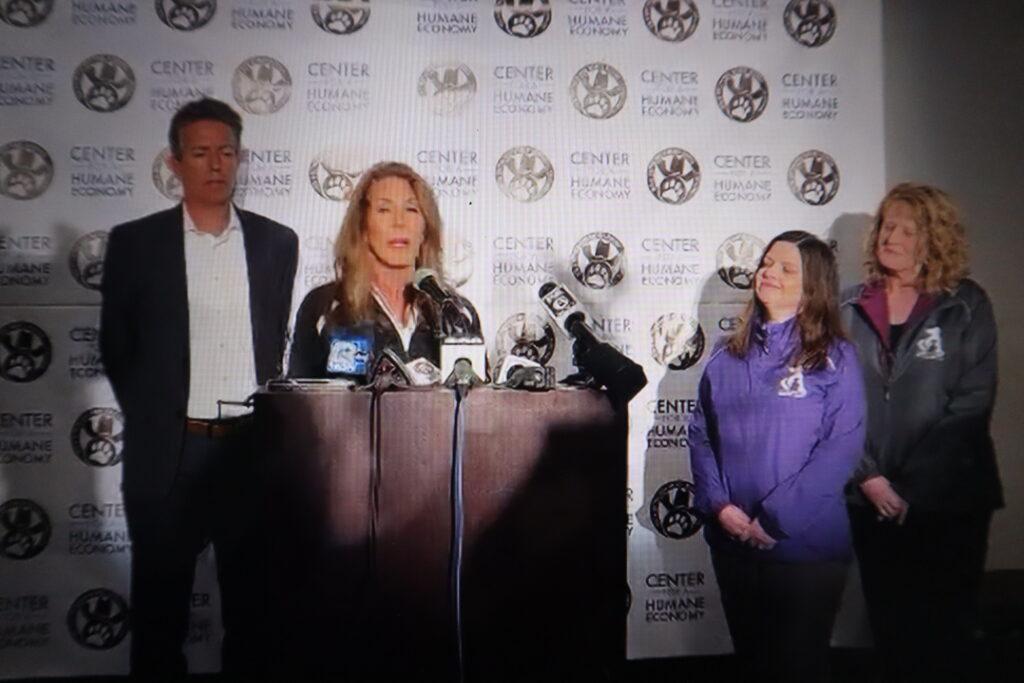


The fate of most of the beagles held at Ridglan Farms took a turn Thursday, when animal welfare groups Center for a Humane Economy and Big Dog Ranch Rescue announced they had reached an agreement with the Dane County dog breeder and research facility to buy 1,500 of the beagles. The dogs will be transferred to the groups for rehabilitation and adoption. Ridglan Farms, which both breeds beagles for testing and maintains its own biomedical research facility, has been embroiled in controversy following multiple recent attempts by animal rights activists to breach the facility and free the beagles held inside.
“This is a moment to celebrate that 1,500 dogs will soon know only the kindness of the most caring people and will be treated for the rest of their lives like little kings and queens,” said Wayne Pacelle, president of the Center for a Humane Economy, at a press conference Thursday. “This life-saving project comes as we also charge ahead with our work to wind down the archaic and inhumane era of animal testing and embrace innovative 21st century strategies that do not harm and deliver more palliatives and cures to people.”
Amy Good of the Dane County Humane Society said during the press conference that the Humane Society will stage 500 of the dogs. At least 50 of the dogs will be up for adoption in Dane County in the coming weeks, Good said. Another 300 dogs will go to Big Dog Ranch Rescue in Florida and Alabama. A nationwide network of partner organizations will help take in the remaining dogs.

During the press conference, Pacelle said that “Ridglan, to my vantage point, looks like it’s winding down operations.” In order to comply with a deal with prosecutors to avoid penalties for violations of Wisconsin animal cruelty laws, Ridglan is required to discontinue its beagle breeding program by July 1. The deal was established last year, after a judge found that probable cause existed that animal cruelty violations had occurred at Ridglan, and appointed a special prosecutor to oversee the case.
Animal rights activists have accused Ridglan of housing the beagles under inhumane conditions, and of subjecting them to painful experiments and procedures — including the removal of eyelids — without anesthesia. In March, a group of activists arrived at Ridglan and, using tools, breached its perimeter fence, and managed to enter one of the buildings housing beagles. The group managed to get 22 beagles out of the facility, eight of which were seized by law enforcement and returned to the farm. The activists argued that because Ridglan was in violation of animal cruelty laws, they had a right to rescue the beagles.
About a month after the first action, a larger group numbering hundreds of people returned to Ridglan Farms but were confronted by law enforcement using rubber bullets and tear gas. Several people were injured and one man lost teeth during a beating by police, activists said. Activists filed a civil lawsuit over the use of force against the Dane County Sheriff’s Office. A lead organizer of the rescue operation, Wayne Hsiung of California, and three others were arrested and charged with felony burglary stemming from the first break-in.
While the recent dramatic actions and clashes with police garnered national media attention, tensions over Ridglan had been brewing for years.
Shannon Keith, founder and president of the Beagle Freedom Project, said that negotiations to get the 1,500 beagles out of Ridglan and into safe homes had been in the works for a long time. “We have built the infrastructure to not only rescue these dogs, but to give them full lives beyond the laboratory system,” Keith said in a statement Thursday. “Every one of these dogs will be treated as an individual deserving of care, healing, and a home.”

Eilene Ribbens, executive director of the Wisconsin Puppy Mill Project, and Pam McCloud Smith, executive director of the Dane County Humane Society, praised the deal to rehome the dogs. “We are proud to stand with the national organizations to help bring these dogs to safety,” said Ribbens.
“This effort reflects the strength of collaboration across the animal welfare community,” said McCloud Smith. “Our focus is on ensuring these dogs receive the care, stability, and support they need to begin their new lives.”
The dogs being taken from Ridglan have never been outdoors or seen grass, the animal welfare groups said. People who adopt the dogs will need to be patient with them and understand that each dog will need time to adjust.
Pacelle said that the effectiveness of animal testing for human medicine and products is being increasingly questioned in the scientific community, and said that Ridglan’s practices are outdated. Pacelle said that, “the only way that we’re going to solve this problem is if the United States takes the next set of steps to defund grant-making to research institutions and others that are using beagles, and primates, and other animals.”
On Wednesday, Congressman Mark Pocan added an amendment to the farm bill that just passed the House of Representatives requiring the U.S. Department of Agriculture to review federal licenses of breeders that have lost their equivalent state-level breeding license, and to take action if it becomes clear that they are no longer eligible for a federal license. The amendment was directly inspired by Ridglan, which maintained a relationship with the federal government despite the controversy surrounding its facility, and its violations of state law.
“If a breeder is turning in their state license due to code violations, the USDA should at least take a look to see if they should be allowed to continue to have this privilege,” said Pocan. “And this situation is so nonpartisan that even Lara Trump and Laura Loomer have spoken out against what’s happening at Ridglan Farms.”
Lead animal rights organizer appears in court
A day before the announcement that 1,500 of the approximately 2,000 beagles housed at Ridglan would be released, Hsiung appeared in Dane County Circuit Court in Madison. “They have threatened these dogs with violence,” said Hsiung, standing outside the courthouse surrounded by supporters and press on Wednesday. “This should’ve been resolved more than 10 years ago.”
Hsiung and others who were involved in the actions at Ridglan have repeatedly condemned local and state government in Wisconsin for allowing the facility to operate despite years of reported concerns. “It shouldn’t be private citizens who have to step up,” said Hsiung, who claimed that the families involved in Ridglan’s operation are well connected to local politicians. “It makes a big difference that the story is getting out.”

A judge found enough evidence to continue a criminal case against Hsiung during the preliminary hearing on charges related to the March break-in. He was represented by attorneys Benjamin Carraway and Kristin Schrank. Prosecutor Mattew Moeser sat at the opposite table, calling only a single Dane County Sheriff detective — Leslie Keith — to the stand as a witness. Court Commissioner Brian Asmus presided over the hearing.
Keith recalled that early on the morning of March 15, dispatchers began receiving 911 calls both from Ridglan employees saying people were entering the facility, and from the activists themselves calling to report animal abuse. Officers arrived from Mt. Horeb, not far from Blue Mounds where the beagle breeding facility is located, and began questioning people and telling them to stop. Several activists were walking around the facility, carrying beagles or attempting to get into more of the buildings.
Moeser played body camera footage from the officers, which Carraway objected to, saying that they’d only been given the video a few seconds before the hearing began and hadn’t been able to review it. The court commissioner allowed the video to be played. “I will put you in handcuffs right now,” an officer yelled at some of the activists. “Everbody stop!” Many of the activists were dressed in white biohazard suits. Hsiung was filmed talking to the officers, describing himself as “a lawyer on site” with a “judicial opinion” regarding Ridglan. “Why are you stopping people from seeing what’s happening?” one person yelled in the body camera footage.
Moeser also played social media videos posted by Hsiung and drone footage showing the activists entering Ridglan. The prosecutor emphasized that the group was breaking into and burglarizing the facility, and ultimately stole more than 20 dogs worth $2,000 each.

Carraway’s attempts to question Detective Keith were repeatedly interrupted by objections by Moeser, which were sustained by the court commissioner. Carraway wasn’t allowed to ask whether law enforcement were already aware of animal cruelty reports at Ridglan. His mention of the surgical removal of beagles’ eyelids was struck down. Carraway also wasn’t allowed to ask why the activists chose to wear the biohazard suits, as well as other questions. “Any defense is not relevant at a preliminary hearing,” the commissioner told Carraway from the bench.
The hearing ended in a debate about bail conditions which had been set by the same court commissioner. Among other things, Hsiung is prohibited from contacting other co-defendants who were charged in the March break-in. Carraway argued that this was unreasonable because Hsiung intends to represent himself at some point, and would need to be able to communicate with co-defendants as witnesses.
Hsiung was also banished from all of Dane County, which Carraway said was a First Amendment violation and could be satisfied with a simple banishment from Blue Mounds and Ridglan. Hsiung is an organizer and is regularly involved in protests and demonstrations in Wisconsin and Dane County, Carraway said. The commissioner opted to keep the no-contact for co-defendants, but loosened the banishment from Dane County, conceding that it was overly broad.